Analytics
Last updated: October 6, 2026
This page documents what SellerCopilot computes, which Amazon data it reads, and what it gives back. It is written to be checked rather than skimmed, so every report and metric below is named the way Amazon names it.
What the product does
SellerCopilot is a subscription analytics application for Amazon selling partners. It connects to a seller's own selling account through Amazon's Selling Partner API, ingests that account's sales, traffic, advertising, inventory, order and financial data once a day, and produces a daily brief: a short written account of what changed in the business and what to do about it, with the figures that produced each recommendation attached.
The product covers Amazon Seller Central accounts. A seller authorizes the application to their own selling account and sees only their own data. Nothing is pooled, benchmarked or compared across customers.
SellerCopilot reads. It does not create, edit, pause or bid on advertising campaigns, and it does not change prices, listings or inventory. Recommendations are for the seller to act on.
The daily brief
Amazon's reports settle one to two days behind the calendar, so the brief is anchored to the most recent date the seller's account actually has data for, not to today. The page states that date, so a reader always knows how fresh the analysis is.
Each morning the brief contains four things:
- Portfolio pulse. Revenue, net profit, ad spend and TACOS for the period, against the preceding one.
- What's new. Every finding classified against the previous fourteen days: flagged for the first time, resolved since yesterday, persistent for seven days or more with no response, or improving because the metric behind it is moving the right way.
- Today's actions. The recommendations themselves, ordered by estimated impact, each with an evidence panel holding the readings it was computed from.
- Recent outcomes. What happened after the seller acted, measured against what was predicted.
How recommendations are generated
Recommendations come from a rule engine, not from a model guessing. Each account is provisioned with nineteen pre-configured rules. Every rule is a stated condition over the account's own metrics, evaluated for each ASIN once a day, against the seller's targets for TACOS, click-through rate, conversion rate and days of stock. Those targets can be overridden per product, and the rules themselves can be edited, disabled or added to.
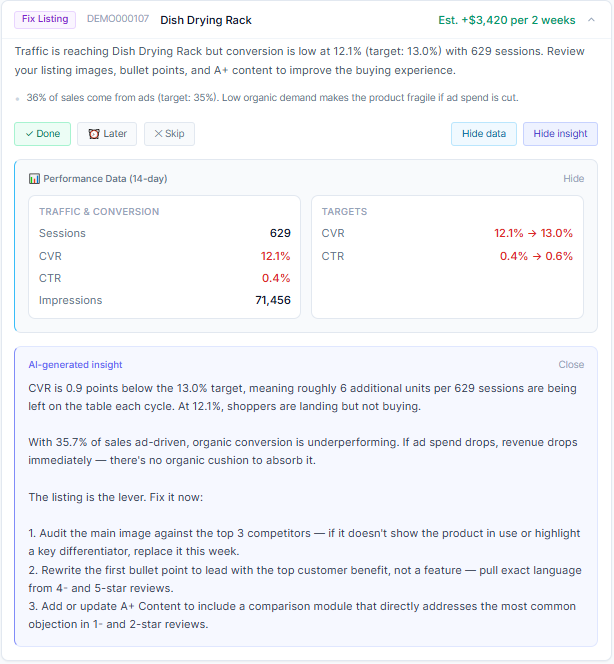
The engine produces six kinds of action: stop ads, reduce ads, scale ads, order inventory, fix listing, and win the Buy Box. Real examples of the shipped rules, named as they appear in the product:
- Stop ads: severe loss and extreme TACOS. The ASIN is losing money per unit and advertising spend is far above its target share of sales.
- Fix listing: low conversion despite good click-through. Shoppers are clicking at or above target and buying below it, which points at the detail page rather than at the campaign.
- Scale ads: efficient with room to grow. Spend is converting inside target and stock supports more volume.
- Order inventory: high demand stockout risk. Days of supply at the measured velocity fall short of the reorder lead time.
- Listing suppressed by Amazon. The listing is not buyable at all, which no amount of repricing fixes.
- Nobody holds the Buy Box. No seller owns it, which usually means the price sits above Amazon's threshold.
Each finding is written up with the readings behind it, the estimated impact of acting over the next two weeks, and the contributing factors the rule weighed. A recommendation the seller marks as done, deferred or skipped stops being raised for a set period, so the brief does not repeat itself. Once acted on, the outcome is computed over the following seven days (fourteen for ads being scaled) and compared with the estimate.
Written reports and an assistant that answers questions about the account's own figures are generated with Anthropic's Claude models. Product names are replaced with neutral placeholders before any request leaves, and restored in the response. How that works is set out on the security page.
Amazon data sources, and what each one is used for
The table below is the complete set of Amazon data the application reads. Report names are Amazon's report type identifiers, and metric names are the field names Amazon returns.
Reports API, by ASIN and day
Finances API, settlement detail
GET_LEDGER_DETAIL_VIEW_DATA
Reports API, FBA inventory ledger
FBA Inventory API
Product Pricing API
Reports API, catalog
Reports API, order history
Amazon Ads API v3, Sponsored Products
Ingestion runs once a day on a schedule the seller sets, in their own time zone, with a rolling window per source: ten days for sales and traffic, eight for advertising, seven for orders. Amazon restates recent figures as they settle, and a rolling window is how the application picks up those corrections instead of keeping the first number it saw.
Profitability and the per-SKU P&L
Seller Central reports revenue well and profit poorly. It will tell a seller what an ASIN sold. It will not tell them what that ASIN earned after every fee, refund, promotion and advertising cost that attached to it.
Net profit per ASIN is built by taking ordered product sales and deducting:
- FBA fulfilment and referral fees, taken per unit from Amazon's settlement records and stamped onto each day's sales as they were at the time, so a fee change does not silently rewrite last quarter's margin.
- Cost of goods, entered by the seller per product.
- Refunds and refund commissions.
- Promotion rebates and other transaction-level charges.
- Sponsored Products spend for the same ASIN over the same period.
The result is a per-SKU profit and loss the seller can read down to the transaction, plus TACOS and ACOS measured against their own target rather than a generic benchmark. It is presented daily, weekly and monthly, with period-over-period and year-over-year comparison, and it is the figure every advertising recommendation is computed against. This is the deliberate difference from a dashboard that reports revenue: an ASIN with growing sales and a negative margin is a problem, and it only looks like one once the fees are in.
Fee estimates are held per marketplace, so an account selling in more than one country does not have one country's fees applied to another's sales.
How access and data handling work
- A seller authorizes SellerCopilot through Amazon's standard Selling Partner authorization flow. No credentials are typed into SellerCopilot.
- The application reads only the data of the account that authorized it.
- Authorization can be revoked by the seller at any time from Seller Central. Revocation stops all further collection immediately.
- No buyer contact details are requested, stored or processed. No email addresses, no names, no street addresses. The repeat-purchase and customer-value analytics need to tell whether two orders came from the same customer, so the identity on an order is a one-way digest, not a person. Alongside it the product keeps coarse location only: city, state or province, postal code and country, used for aggregate geographic analysis.
- All traffic is served over HTTPS/TLS. The Amazon credentials that authorize access are encrypted with AES-256-GCM before they are written, with the key held separately from the database. The database is a managed PostgreSQL service that encrypts data at rest, including backups.
- Data is retained while the account is active and for 30 days after cancellation or after access is revoked, after which it is deleted. A seller may request deletion at any time before that.
The security overview sets this out in more detail, including what SellerCopilot does not claim, and the privacy policy covers the rights a seller has over their data.
Pricing
US$79 per month, with a 14-day free trial. The trial needs no payment to start and gives access to the full application. See pricing for what is included.
Questions
For anything this page does not answer, including from a security or compliance reviewer: [email protected]. See also the security overview and the privacy policy.